

.svg)
.svg)
.svg)
.svg)

.svg)
.svg)
.svg)

Updated and tested 3 November 2026
If you're picking a file server for yourself or a small team in 2026, pick Nextcloud. That's my verdict up front, and I'll spend the rest of this article earning it, because the interesting part is the why. The ownCloud vs Nextcloud question stopped being a fair fight years ago, and the reason has less to do with one project beating the other than with ownCloud walking off to compete for entirely different customers.
I say this as someone who ran ownCloud before the fork and has run Nextcloud at home and for clients since around version 24, currently on a 4 GB VPS holding 400 GB of family photos and project files. I've watched both projects the whole way. Here's where they stand.
The 2016 fork in two paragraphs
Nextcloud is a fork of ownCloud. In 2016 Frank Karlitschek, who had started ownCloud in 2010, resigned from the company he founded over disagreements about its direction, in particular the balance between the open source community and the commercial side. Weeks later he announced Nextcloud, and most of the core developers followed him. The US arm of ownCloud shut down shortly after, while the German company carried on.
The codebases were identical on day one, down to the bugs. For a few years the two servers looked like siblings, same PHP core, same sync protocol, drifting apart one release at a time, and forum answers for one mostly worked on the other. That period is over, and comparing them today means comparing two genuinely different products, which older comparison posts (and there are many still ranking) tend to miss. If you're reading a "Nextcloud vs ownCloud" piece that talks about them as near-twins with different logos, check its date.
What ownCloud is in 2026
ownCloud has been part of Kiteworks, an American content security company, since the acquisition was announced on November 21, 2023, together with the German vendor DRACOON. Kiteworks has since set up an open source program office under the ownCloud brand and retired the old contributor license agreement, which credit where due, is a better outcome than open source projects usually get from an acquisition.
The product itself changed even more than the ownership. The newer line is ownCloud Infinite Scale, oCIS for short: a complete rewrite in Go, shipped as a single binary under the Apache 2.0 license. There's no PHP stack in it and no separate database server behind it. You download one file, run it, and you have a file sync server with its metadata handled by its own storage backend. It is fast, and it's a genuinely modern piece of engineering aimed at large deployments and the enterprise compliance market Kiteworks lives in.
The classic PHP server is still developed alongside it. ownCloud 11 shipped on 30 July 2026 and is the maintained PHP line now, while the 10 series gets maintenance releases until its end of life in January 2027 (both dates from the ownCloud core maintenance schedule). A new ownCloud install today means choosing between ownCloud 11 and oCIS.
What Nextcloud is in 2026
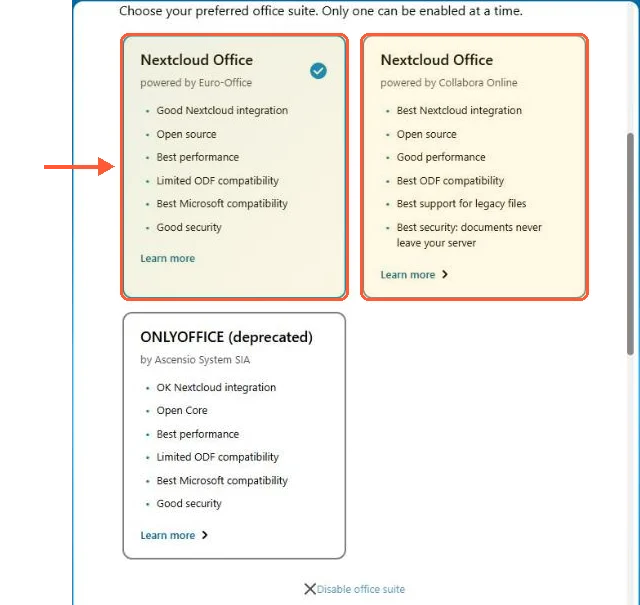
Nextcloud kept the PHP architecture and built upward. The server is on version 35 (35.0.2 since mid-October 2026; the marketing name is Hub 26 Summer, a seasonal scheme that takes some getting used to), with a new major every four months and development happening in the open on github.com/nextcloud/server. It stopped being a Dropbox alternative somewhere around version 20 and became a collaboration platform: file sync at the core, plus Talk for calls and chat, office editing through Collabora or Euro-Office, calendars and contacts, an AI assistant and an app store with hundreds of community apps covering everything from photo timelines to two-factor hardware keys.
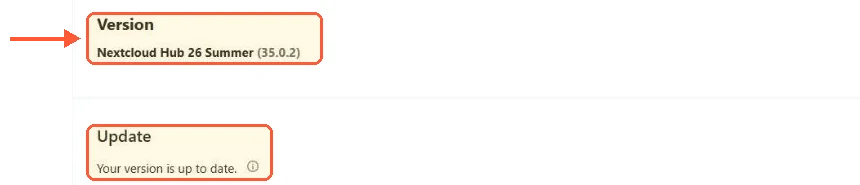
My test instance after the move to 35: Hub 26 Summer, 35.0.2, nothing newer on the stable channel.
The licensing model matters as much as the features. Everything is AGPL, and files, sync, sharing, Talk and Office all ship in the free release. A Nextcloud Enterprise subscription comes in three tiers (Standard, Premium and Ultimate) and buys support, longer maintenance windows and someone to call; the features it adds are a few enterprise connectors, such as Exchange and Global Scale in the higher tiers, and Oracle Database support. There's no open-core split where the self-hosting parts sit behind a paywall, which was one of the original fork grievances, and ten years on the project still holds that line.