

Keep Claude Code and everything it touches on a server of its own, with a transcript of what it did and a snapshot from before it did it.
*Bez VAT.
DOSTĘPNE W KAŻDYM PLANIE
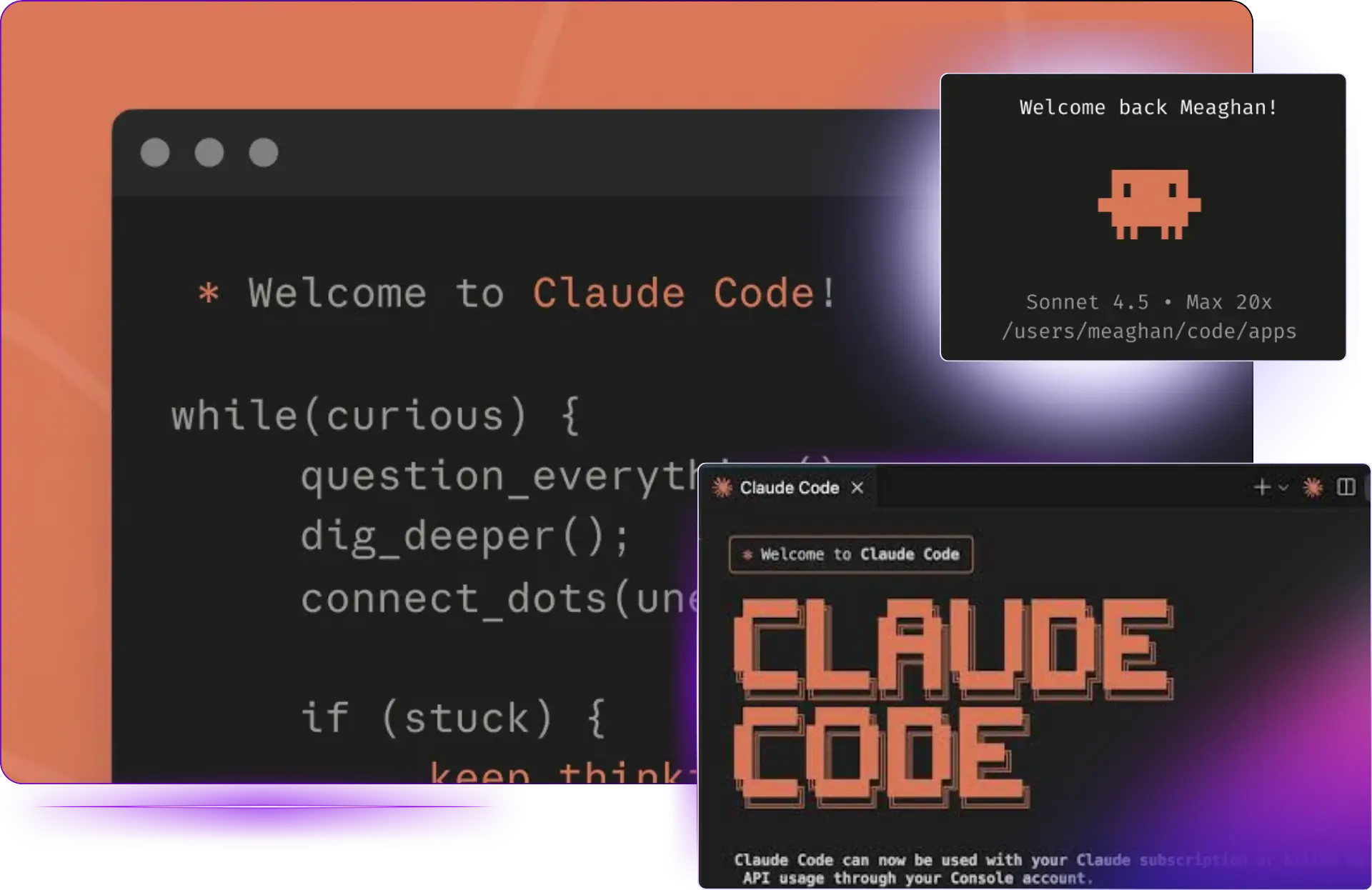
Claude Code is Anthropic's coding agent, driven from a terminal and wired into your editor, your MCP servers, your hooks and any subagents you have defined. It reads a project, plans a change, edits the files and runs the tests. Access comes from a Claude subscription or Anthropic API credits, billed by Anthropic rather than by us. Our template adds transcript logging, so every session leaves a readable record of the work.
A server suits it for reasons that stack up on each other. The machine stays on, so a long task continues after you disconnect and you pick the session back up from wherever you are next. The environment stays put as well, which means the agent meets the toolchain it met yesterday rather than whatever your laptop has become since. Full root then lets it install a dependency or start a service without stopping to ask, and that is most of the difference between an agent that helps and one that keeps interrupting you.
Start a task in tmux over SSH, then reattach from a different machine later.
The agent installs the packages and starts the services the job needs.
Read back what a long run did, rather than working it out from the diff.
Long tasks and hotel wifi are a poor match. Run the agent inside tmux over SSH and the session carries on when the laptop sleeps, then reattach later and read back what happened while you were gone. Our SSH and tmux walkthrough has the exact commands.
An agent that pauses for approval on every command is doing half a job. Anthropic's guidance for turning those prompts off is a container or a virtual machine, running as an ordinary user, with outbound access limited to what the task needs. A VPS is precisely that shape. Take a snapshot before a long unattended run and you have a clean restore point as well. The permissions guide covers the safer setups.
When the agent shares a machine with the code it edits and the service that runs it, a change gets written and tested in one place. Nothing to sync and no deploy step in between. A Docker VPS fits this well, since most projects want containers underneath in any case.
A server settles the question of why something worked on one laptop and not another, because there is only one toolchain. Transcript logging answers the other team question, which is what a given session was asked to do and what it did in response.
Both are terminal agents and both install in one click here. Claude Code is Anthropic's own and the natural choice if your subscription already sits there. OpenCode is MIT licensed and accepts any provider you hand it, which suits anyone comparing model prices or working against a local model. Keeping both on the same server costs nothing but disk.
Claude Code Router and similar proxies point the CLI at other model providers, either for cost control or for a model Anthropic does not serve. The proxy runs as a local process beside the agent, so a server is the natural home for it. The OpenRouter guide has the configuration.
Wdróż dowolny szablon, a certyfikowani specjaliści zajmą się wszystkim na poziomie serwera, 24/7 i w wielu językach. Jest w cenie każdego planu, dopracowane przez 17 lat utrzymywania infrastruktury.
Installing a runtime, adding a system package or starting a service all need genuine root, which KVM gives you rather than approximating. One thing to set up on day one: the CLI declines to skip permission prompts when it was started as root, so create an ordinary user before you get to that stage.
Take one before you leave the agent to a large task and you have a marked point to return to, which is the same habit as committing before a risky refactor. Scheduled backups cover the days you forget.
The agent itself is light. The memory goes to the project it compiles, the containers it starts and the tests it runs, so the right size is the one your build wants. Begin on a small plan and live resize in a few minutes when that changes.
A public address and full SSH access mean the session is available from a desk, a laptop or a machine that is not yours. Locations across Europe, the UK and the USA let you put it near the rest of your stack and keep the round trip short.

Dobra cena za to, co dostajesz
2025-12-29"Korzystam z ich usług już od jakiegoś czasu i jestem bardzo zadowolony. Wydajność jest dobra i stabilna, a cena tylko to podkręca. Wszystko po prostu działa płynnie, a jak czegoś potrzebujesz, odpowiadają bardzo szybko."
Świetny zespół i firma
2025-03-01"Świetny zespół i firma. W miarę jak udostępniają swoje usługi w kolejnych regionach świata, rozwijają także jakość i efektywność działania."
Konfiguracja poszła szybko, a...
2025-09-01"Konfiguracja poszła szybko, a VPS od tamtej pory działa bez zarzutu. Obsługa klienta odpowiedziała na moje pytania bez niepotrzebnego komplikowania sprawy i szczerze mówiąc bardzo mi się to spodobało."
LumaDock oferuje szybki i przystępny cenowo hosting VPS, GPU oraz serwerów dedykowanych dla deweloperów, firm i graczy, oparty na pamięci NVMe i procesorach AMD EPYC.
LumaDock® jest zastrzeżonym znakiem towarowym LumaDock LTD z siedzibą w Londynie W1S 1HN, Wielka Brytania, zarejestrowanej w Anglii i Walii pod numerem spółki 15844051.
GPU products are in high demand at the moment. Fill the form to get notified as soon as your preferred GPU server is back in stock.
We'll notify you when your preferred server is back in stock.