

.svg)
.svg)
.svg)
.svg)

.svg)
.svg)
.svg)


Updated and tested 30 October 2026
Most searches for a Jellyfin alternative start from one of two complaints. Either there's a TV in the house with no Jellyfin app available, such as a PlayStation or a Samsung older than Tizen 6, or there's a library type Jellyfin handles poorly, which in practice means a large music collection or photos of any size. Those are different problems with different fixes, and only the first one is solved by swapping the whole server out. The list of Jellyfin alternatives below is sorted by which problem each option solves.
Full media server replacements
Two products do everything Jellyfin does for films and series and can take over the whole library. Both are closed source and both sell a subscription; the difference is what the subscription gates.
Plex
Plex is the one with an app in every store, including Samsung and LG TVs, PlayStation and Xbox, which is what tempts households away from Jellyfin. The server is free. Since April 29, 2025 (April 29, 2026 for Fire TV, smart TVs and consoles), remote playback of personal media needs either a Plex Pass on the server owner's account or a Remote Watch Pass on each viewer's. Hardware transcoding and DVR are Plex Pass features, and the lifetime pass tripled in price on July 1, 2026. A plex.tv account is required to claim the server and sign apps in, which is how Plex ended up sending two breach notices, in 2022 and September 2025.
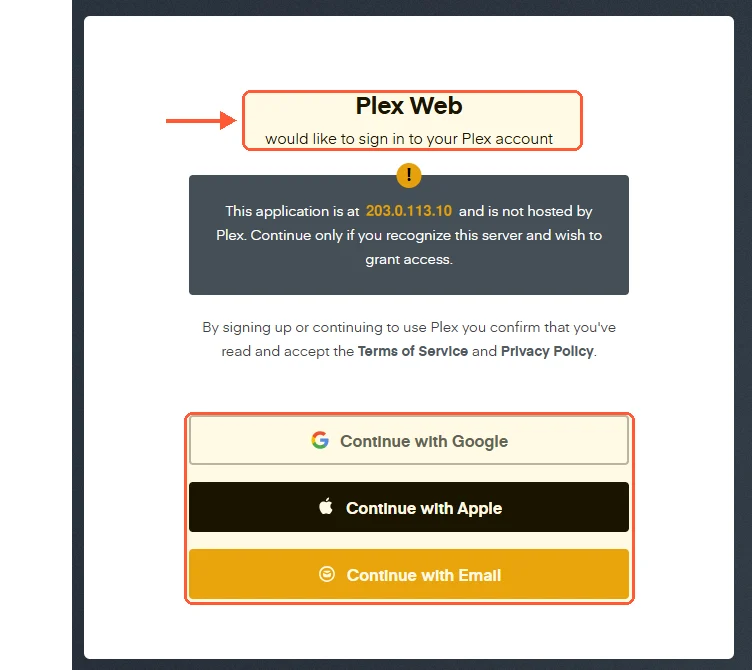
Before I claimed the server on my VPS, Plex Web started by asking for a Plex account.
On a VPS the remote rule bites harder than at home, because every viewer of a hosted server is remote. That single point, plus the price moves, is the core of the Jellyfin vs Plex comparison; the short version is that Plex is the right pick when the TV app store matters more than the subscription.
Emby
Emby is Jellyfin's parent. The projects split in December 2018 when Emby went closed source, and the two still look alike and use the same media naming rules. Emby Premiere gates hardware transcoding, live TV and DVR, offline downloads and full playback in the mobile apps, but it has never gated remote access, and the Emby app is in the Samsung and LG stores. Stable is 4.10.2.0 from October 2026 with 4.11 in beta. Without Premiere it still streams locally and remotely, and the key is what buys DVR, hardware transcoding and the unlocked mobile apps. The rest of the trade-offs are in Emby vs Jellyfin.
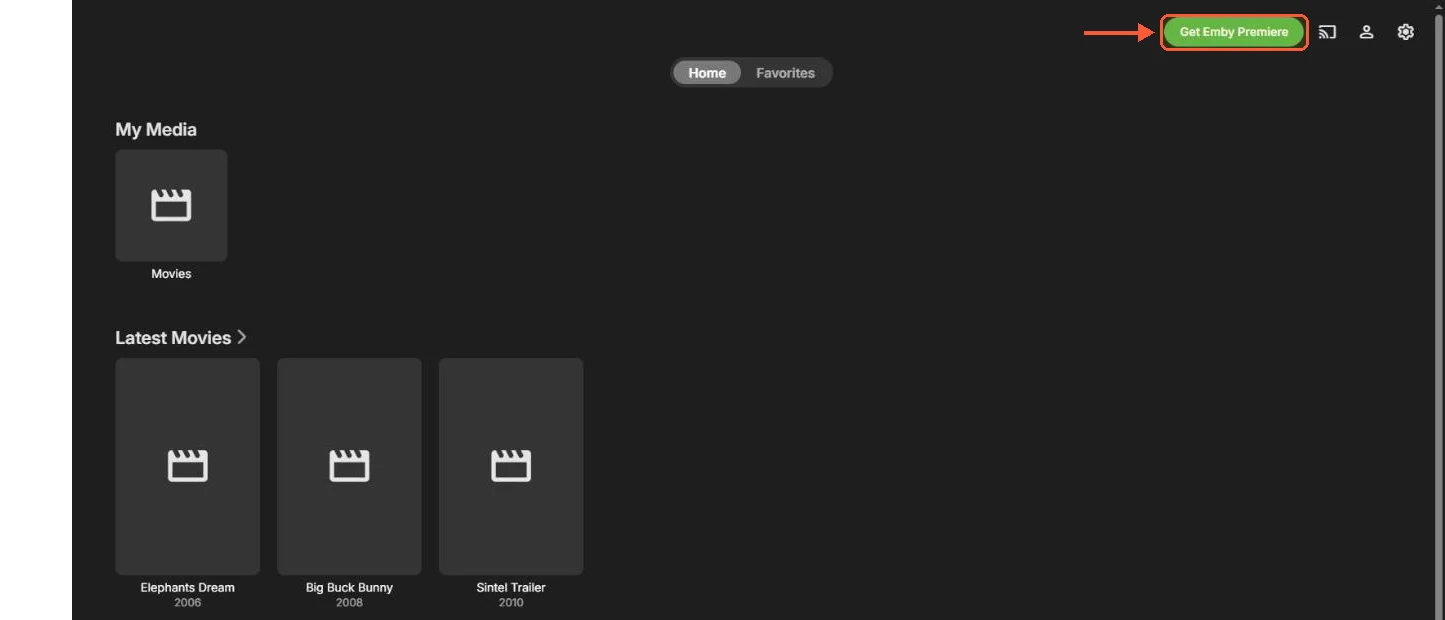
Emby 4.10.2.0 on my server without a Premiere key: the library is there, with Get Emby Premiere in the top bar.
Front ends that need a server behind them
These get listed as Jellyfin alternatives constantly and none of them are. They're players. Each one still needs a server, a share or a streaming source to read from.
Kodi
Kodi is the media centre that used to be XBMC. It plays from local disks, NFS and SMB shares and from add-ons, keeps its own library database and runs on Linux, Windows, macOS, Android, Apple TV and single-board computers through LibreELEC. Stable is 21.3 "Omega" from December 2025; 22 "Piers" reached release candidate 1 on October 10, 2026, per the Kodi blog. There is no Kodi server. If you want one Kodi box to know what another has watched, something else has to hold that state.
That something is usually Jellyfin. The Jellyfin Kodi add-ons come in two flavours: Jellyfin for Kodi, which syncs the server's metadata into Kodi's local database so the library behaves as if it were native, and JellyCon, a lighter add-on that browses the server without syncing and copes better with multiple servers or users. Pairing Kodi with Jellyfin is a better outcome than replacing Jellyfin with Kodi, because you keep watched-state sync and user accounts and gain Kodi's player and skins. Replacing trades the first two for the second two.
Stremio
Stremio is an add-on driven player: you install add-ons that supply streams from external sources and it plays them with a Netflix-style catalogue on top. It has a local files add-on but no library management, no per-user accounts on your hardware and no server component of yours to back up. People who want the catalogue experience without running anything pick it. People with 4 TB of their own files on a disk don't.
Infuse
Infuse is a player for iPhone, iPad, Apple TV, Mac and Vision Pro (free to download, with a paid Pro tier) that connects to Jellyfin, Plex, Emby or a plain SMB share and does its own metadata and playback. On Apple hardware it's the answer to "the official Jellyfin app is rough on tvOS", and it's a client, so it belongs here.
Single-purpose servers that beat Jellyfin at one library
Jellyfin's music and photo support exists, and both are the weakest parts of the product. Running a specialist next to Jellyfin for those libraries is common enough that the specialists have become the default recommendation.
Navidrome for music
Navidrome is a small Go server for tagged music libraries that speaks the Subsonic API, which means any Subsonic client works with it: Symfonium and DSub on Android, play:Sub on iOS, Feishin on desktop. It scans fast, handles multi-disc albums and classical tagging better than Jellyfin's music library, supports multiple users and transcodes on the fly for mobile data. Open source (GPL-3.0), no licence key or cloud account, one binary.
Immich for photos
Immich is a self-hosted photo and video library with mobile apps that back up the camera roll automatically, machine-learning search by description, face grouping and shared albums. It's the closest thing to a self-hosted Google Photos, and it's what Jellyfin's photo library is not. It runs in Docker with Postgres and a cache service alongside it, so it's heavier than Jellyfin; the Immich complete guide covers the install, storage layout and hardware acceleration on a VPS.
Audiobookshelf for audiobooks and podcasts
Audiobookshelf manages audiobooks and podcasts with per-user progress sync, chapter support and its own Android app, plus an iOS app in TestFlight beta. Jellyfin will play an audiobook folder as music, which loses chapters and position. If audiobooks are more than an afterthought, this is a straight upgrade.