

.svg)
.svg)
.svg)
.svg)

.svg)
.svg)
.svg)

Updated and tested 28 October 2026
Decide first which half of Nextcloud you're replacing, because most Nextcloud alternatives cover only one. Nextcloud is two products in one install: a file sync and share server, and a groupware suite with an app store sitting on top of it. Nearly everything on this page replaces the first half and ignores the second. If Talk and Nextcloud Office are why Nextcloud is on your server, no single project here covers that, and you'll come out of the migration running two services where you had one.
This page covers nine projects, grouped by what each one does: file servers with their own sync clients, web front-ends over storage you already run, one peer-to-peer tool with no server at all and one photo app. Versions and dates are as of late October 2026, with Nextcloud Server 35 (shipped as Hub 26 Summer on 16 September 2026) as the reference point. All-in-One installs of Nextcloud still begin on Hub 26 Spring (34) unless the Hub 26 Summer checkbox is ticked ahead of the first launch: my test install came up as 34.0.5, and AIO's upgrade button moved it to 35 later.
One thing to rule out before the list. Plenty of people leave over the install itself, or over a PHP upgrade that ate a Saturday. If setup effort is the whole complaint, the one-click Nextcloud template removes the build, so you keep the app and drop the install work. Slow browsing on a big library and a database you'd rather not run are better reasons to move.
Alternatives that replace Nextcloud Files
OpenCloud
OpenCloud is a fork of ownCloud Infinite Scale, run by OpenCloud GmbH, founded in September 2024 as part of the Berlin-based Heinlein Group (the same group behind mailbox.org). The server is Go under Apache 2.0, the Vue web UI is AGPL-3.0 and the desktop client is GPL-2.0, so the licence answer depends on which piece you're asking about. The rolling channel is at v9.0.0, released 27 October 2026, with two breaking changes, a push-based thumbnailer architecture and a new auth-guest service for guest links. Earlier, v7.5.0 on 25 August added end-to-end encrypted vaults that cover filenames as well as contents, an EPUB reader and an .ocnote note format. The lifecycle page separates three channels: rolling releases about every three weeks, production releases about every six months and LTS releases with two years of backports. The production line is at 7.2.4 from 21 August, and the next production release is listed for 17 November 2026. Around 6,200 GitHub stars.
Storage is where OpenCloud differs most from Nextcloud. New installs default to PosixFS, which keeps your files as an ordinary directory tree with metadata in extended attributes and no database behind it, so a backup is a filesystem snapshot and nothing else. Collaborative mode, switched on with STORAGE_USERS_POSIX_WATCH_FS=true, goes one step past that: external processes can write into the tree and OpenCloud picks up the change in real time, which makes rsync or another user's shell session valid ways to put files in. The default mode expects the tree to be left alone while OpenCloud runs. The other driver is DecomposedS3, for S3-compatible object storage such as MinIO. There is no migration path from DecomposedFS to PosixFS without copying the data, so this is a decision you make at install time.
If you're leaving Nextcloud for files alone and you want plain files on disk, I'd try OpenCloud first, because PosixFS keeps the tree readable by anything else on the box, and once .env is copied from .env.example and filled in, the Compose setup is a single docker compose -f docker-compose.yml -f traefik/opencloud.yml up -d.

The compose route on my server: OpenCloud 9.0.0 behind Traefik on 80 and 443.
Spaces have no exact counterpart in Nextcloud, and the OpenCloud vs Nextcloud writeup has the feature-by-feature version of this. They're team folders as a first-class primitive, with delegated admins, their own quota and their own membership list. Documents come from Collabora Online or Euro Office over WOPI, wired in as extra compose files alongside Tika for content extraction, ClamAV over the clamd socket and Radicale for CalDAV and CardDAV. Against all that, the App Store is a small one for web extensions (21 apps on my 9.0.0 server), there are no video calls and groupware stops at calendar and contacts.
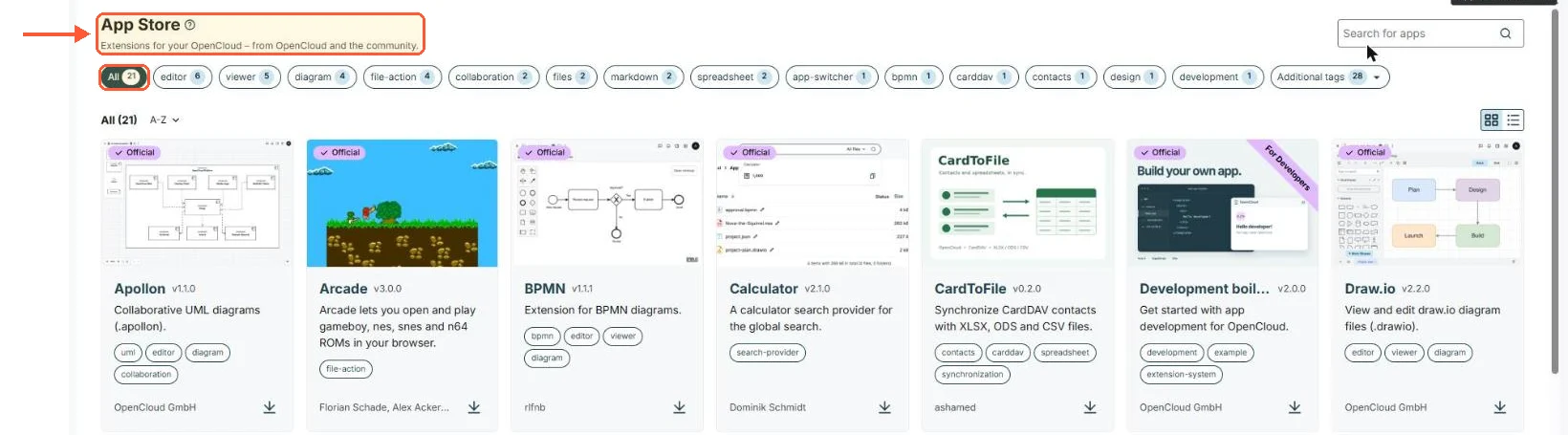
OpenCloud 9.0.0's App Store on my test server listed 21 web extensions.
ownCloud classic and ownCloud Infinite Scale
ownCloud is two separate products sharing one name, and picking the wrong one wastes a weekend. Classic ownCloud is the PHP application under AGPL-3.0. Version 11.0.0 shipped on 30 July 2026 with PHP 8.3 as the minimum, 11.0.1 followed on 25 September, and the 10.x line received 10.16.6 on 6 October. It keeps files as plain files on disk, which is the reason a lot of long-running installs never left it. Infinite Scale (oCIS) is the rewrite in Go under Apache-2.0, at 8.2.2 on 21 October 2026 with a 9.0.0 release candidate out since 12 October, with DecomposedFS as the default driver, PosixFS available, Spaces as the sharing model and an MFA-protected Vault added in the 8.x line. If you read a forum thread about ownCloud and it doesn't say which one, assume it's about the classic PHP version.
Kiteworks has owned ownCloud since the merger announced in November 2023, the event that preceded OpenCloud's fork of Infinite Scale, and the Nextcloud and ownCloud comparison goes through what that changed for the codebase. In May 2026 Kiteworks launched an ownCloud Open Source Program Office, replaced the contributor licence agreement with a DCO and started relicensing projects to Apache-2.0. Star counts are modest for a project this old: around 2,100 on oCIS and around 8,800 on the classic core. The desktop app is at 7.1.1.
Seafile
Seafile is the quickest of these at moving a lot of small files, and the least willing to show you what it did with them. The server core is AGPL-3.0, the desktop sync engine GPL-2.0 (its GUI is Apache-2.0) and Seahub (the web front-end) Apache-2.0. It needs MySQL or MariaDB, and three databases at that: ccnet_db, seafile_db and seahub_db. Community Edition is at 13.0.28 from 18 September 2026, with a 14.0.9 beta out since 14 October. Seafile announced 13.0 on 5 January 2026 (the first stable build, 13.0.12, dates from October 2025), with a metadata server that puts Table, Kanban, Gallery and Map views over your files, plus SeaDoc 2.0 for collaborative documents. The Docker image is seafileltd/seafile-mc, tagged 13.0-latest.
Files are not browsable on disk. Seafile stores library contents in an internal Git-like content-addressed block format, and recovery goes through seaf-fsck, Seafile's own consistency checker, when the databases and the block store disagree. What you find under the data path is a tree of hashed blocks with no filenames in it and no directory structure you'd recognise.
That layout was a sound engineering call for what Seafile was built to do. Content-addressed blocks give you deduplication across libraries, cheap versioning and delta sync that ships only the chunks that changed, which is a large part of why Seafile still wins on a folder of 40,000 small files where a PHP application spends its life in stat calls. The same properties make it a poor archival format, because the bytes on disk mean nothing without the software that wrote them.
So: I wouldn't put an archive I care about into Seafile unless I accept that the on-disk format is a content-addressed block store I can only read back through Seafile.
WebDAV exists through SeaDAV and it's disabled by default. Set enabled = true in conf/seafdav.conf and it serves at /seafdav/.
The edition split matters more here than elsewhere on this page, and the Seafile and Nextcloud comparison puts the numbers side by side. Pro is free for up to three users and paid per user above that, and it's Pro that carries LDAP and AD, SSO, full-text search, audit logs, high availability and the S3 storage backend. Community Edition covers everything else. The desktop client is at 9.0.22 for Windows, macOS and Linux, SeaDrive 3.0.27 gives you a virtual drive, and the mobile apps are at 4.0 on both platforms. Around 15,400 stars; the vendor is Seafile Ltd in Beijing, which is a fact some buyers care about and others don't.
Pydio Cells
Go microservices under AGPL-3.0, running on MySQL or MariaDB, with PostgreSQL added as a primary database in Cells 5.0. Datasources are the model here: you attach local filesystem paths, S3-compatible buckets, GCS or Azure, and Cells indexes what it finds behind them. WebDAV works. There are official iOS and Android apps. Around 2,300 stars, Docker image pydio/cells. The open-source build is Cells Home, described on the download page as limited features for home usage, with Enterprise sitting above it.
The desktop sync client is where this gets awkward. CellsSync's last release was v0.9.4 in February 2023, which is more than three and a half years of silence on a component that sits at the centre of a file sync product. The current version of the Cells 5 line is also hard to pin down from the official pages: GitHub lists v5.1.0 from 30 September 2026 as the latest Cells 5 release, while the v4 line was patched at 4.4.18 on 6 October. Check which line your Pydio edition ships before you plan around a version number.
FileRun
FileRun is proprietary, a PHP application on MySQL 8.4 or newer (MariaDB 10.11+), and it's the one on this page that points at a directory you already have and manages the files where they sit. Nothing is renamed or hashed, and a file you drop in over SSH shows up in the web UI. Versioning is calendar-based: 2026.3.0 shipped in September 2026, 2026.2.0 in April added Nextcloud iOS app compatibility, and 2026.1.0 before it added PHP 8.4 support, Collabora and Microsoft 365 editing and streaming resumable uploads. Full-text search needs Tika and Elasticsearch bolted on the side.
The free edition is gone. What's left for individuals is the Home Edition, a one-time perpetual licence covering 5 accounts and restricted to non-business use, with per-user annual business plans and a non-profit plan alongside it. The client story is the unusual bit: FileRun documents setup with the Nextcloud desktop sync app, where you point the client at the root of the FileRun install, and the 2026.2.0 changelog added Nextcloud iOS app compatibility on top of FileRun's own iOS and Android apps. For anyone with a fleet of machines already running the Nextcloud client, that's a migration you can do without touching the endpoints.
Web front-ends over storage you already have
Filestash
Filestash is a stateless web file manager in Go under AGPL-3.0 that connects to storage rather than owning any: S3, SFTP, FTP, WebDAV, SMB, NFS, MinIO, Azure Blob, Git, SharePoint, Dropbox, Google Drive and the local filesystem, among others. There's no database anywhere in it. The docs put the requirement at 128 MB of RAM and one core, which is the smallest footprint of anything here.
Two constraints to know before you commit to it. The free Hobby plan is self-hosted under AGPL v3 and capped at three users. The Self Served plan adds a commercial licence plus SSO (SAML, OIDC, LDAP) and RBAC, and Enterprise adds unlimited users, audit, whitelabelling and HA. And there are no versioned releases: the Docker image machines/filestash ships a rolling latest, so pinning a version isn't an option and neither is reading a changelog before you pull. Around 14,800 stars, led by Mickael Kerjean. The homepage advertises an "On Demand Sync" desktop and mobile app, and the README links an AGPL desktop sync client, fdrive, with no tagged releases; the pricing page doesn't say which plan supports it.
Copyparty
Copyparty is one Python file under MIT, copyparty-sfx.py, and it speaks HTTP(S), WebDAV, SFTP, FTP, TFTP and SMB with an optional SQLite index. Version 1.20.26 landed on 14 October 2026. It's what you reach for when someone needs a directory exposed over six protocols in the next ten minutes.
Sync without a server
Syncthing
Syncthing removes the server entirely. It's MPL-2.0 Go, peer-to-peer continuous sync between devices you control, with no paid edition and nothing to log into from outside. v2.1.7 came out on 21 October 2026. The 2.0 line moved the index database from LevelDB to SQLite and set three simultaneous connections between peers as the default. Deletion records are dropped from the database after six months by default, so a device that stays offline longer can bring deleted files back.
What you give up is most of what makes Nextcloud a server: there are no web sharing links and no per-file permissions, because there's no web interface for anyone except the admin of each node. Nobody signs into Syncthing; devices pair with each other and access stops there. The official Android app was discontinued in December 2024, and Syncthing-Fork is the community successor most Android users run now. On iOS there's no official client; third-party apps such as the open-source Synctrain and Möbius Sync fill the gap. Around 90,000 stars, which is more than every other project here except Immich.
Where it fits is a laptop and a box with a lot of spinning disk holding the same folders, plus a phone if you can live with the client situation. When that box is the point and you need capacity more than IOPS, a storage VPS on HDD is a sensible target for it. Syncthing doesn't care what filesystem sits underneath as long as it can watch for changes.
Photo-only replacement
Immich
Immich does photos and videos, and nothing else. No documents and no arbitrary file sync. It's AGPL-3.0, at v3.3.5 since 21 October 2026, with about 118,000 GitHub stars, which makes it the most-starred project in this roundup by a wide margin. People who move here from Nextcloud usually keep Nextcloud for files and hand the camera roll to Immich, and the Immich and Nextcloud comparison sets out the trade-offs in doing that. It wants PostgreSQL with vector extensions and a machine learning container, so the install is heavier than Filestash or Syncthing by a long way.
What none of them replace
Nothing on this list gives you Talk, Nextcloud's video and chat component. Nothing gives you the Groupware bundle of Calendar, Contacts and Mail in one install either, though OpenCloud gets partway with Radicale for CalDAV and CardDAV. There's no mail client anywhere on this page.
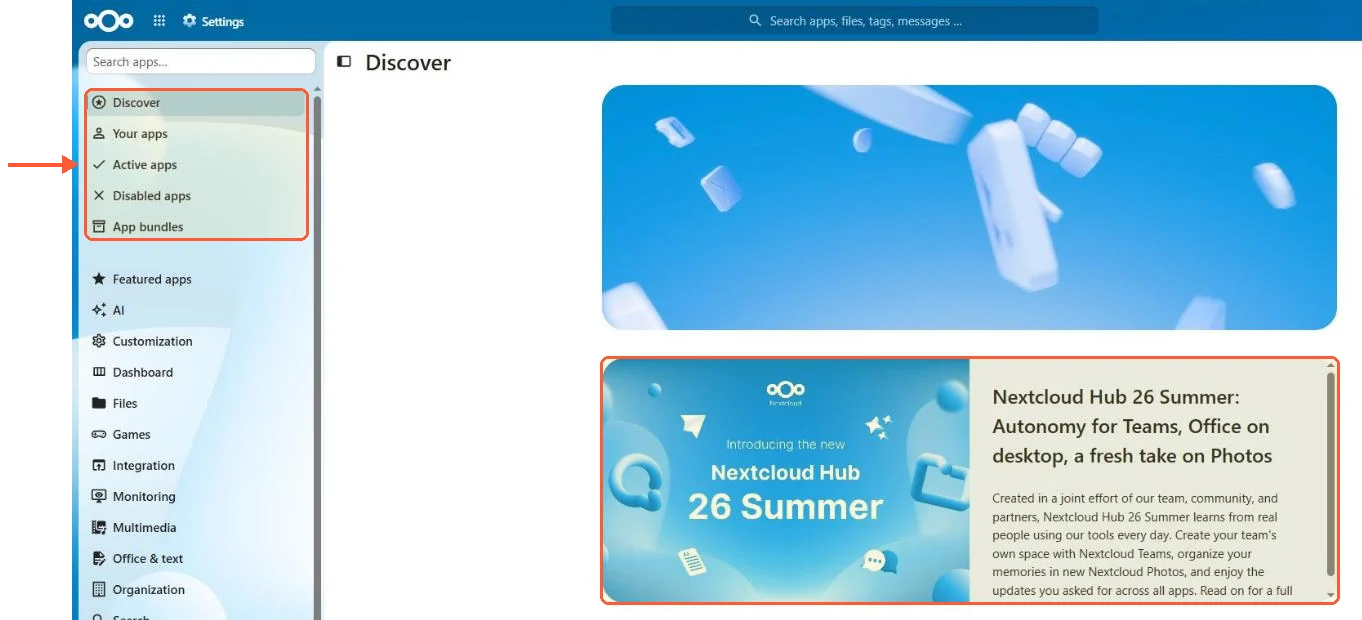
Nextcloud's app store on my test server, opened on Discover with the app categories down the side.
Office is a partial exception. Nextcloud Office is backed by Collabora or Euro Office, and OpenCloud, Seafile (through SeaDoc) and FileRun all have document editing of some kind, so the gap there is smaller than it looks. Nextcloud Assistant and Nextcloud Flow have no equivalent. And none of them matches the Nextcloud app store, which is the one asset nobody here replaces.