.svg)
.svg)
.svg)
.svg)

.svg)
.svg)
.svg)


Updated 22 October 2026
Suricata vs CrowdSec is a question I get asked a lot, and I run both, so let me start by spoiling the ending: it's the wrong question. Suricata inspects network packets... CrowdSec reads logs. They watch different layers of the same attack and replace each other about as well as a smoke detector replaces a door lock. CrowdSec's own team said the same in their Suricata vs CrowdSec post back in 2022.
But "they're complementary" is a cop-out if you have one server and a budget of .... well, zero :) so after the framing I'll answer the question properly, per deployment, with a winner each time.
What Suricata sees that CrowdSec doesn't
Suricata is a NIDS/IPS (Network Intrusion Detection and Prevention System) maintained by the nonprofit OISF, currently at stable release 8.0.5 as of May 2026 per the Suricata download page. It sits on a network interface and performs deep packet inspection against signature rulesets like ET Open: tens of thousands of rules matching exploit payloads, C2 beacons, protocol anomalies and malware traffic on the wire. Run inline, it drops the packet before your application ever processes it.
Its pedigree shows in who embeds it. Commercial firewalls across the market embed it quietly, OPNsense ships it as the built-in IDS and AWS's managed network firewall speaks its rule language. The engine is GPLv2 and the rules travel separately, with ET Open free and commercial rulesets layered on when you need faster coverage of new threats.
The killer capability is seeing what never becomes a log line. A port scan against closed ports, a DNS exfiltration channel, a worm probing SMB across the LAN, an IoT gadget quietly calling home to somewhere ugly. None of that appears in nginx or auth logs, because logging requires a service that accepted the connection and felt like writing something down. My OPNsense box at the edge has flagged exactly one compromised device in four years (a no-name camera), and that single catch justified every hour of rule tuning. Log-based tools were structurally blind to it.
What CrowdSec sees that Suricata doesn't
Flip it around and the blind spot swaps sides. Most attack traffic in 2026 arrives inside TLS, and on the wire Suricata sees ciphertext plus some handshake metadata unless you build TLS interception, which almost nobody sanely does. Your web server decrypts that traffic and writes the plaintext story to its access log, which is exactly where CrowdSec reads. Credential stuffing over HTTPS looks like noise to a packet inspector and like an unmistakable pattern in a log file.
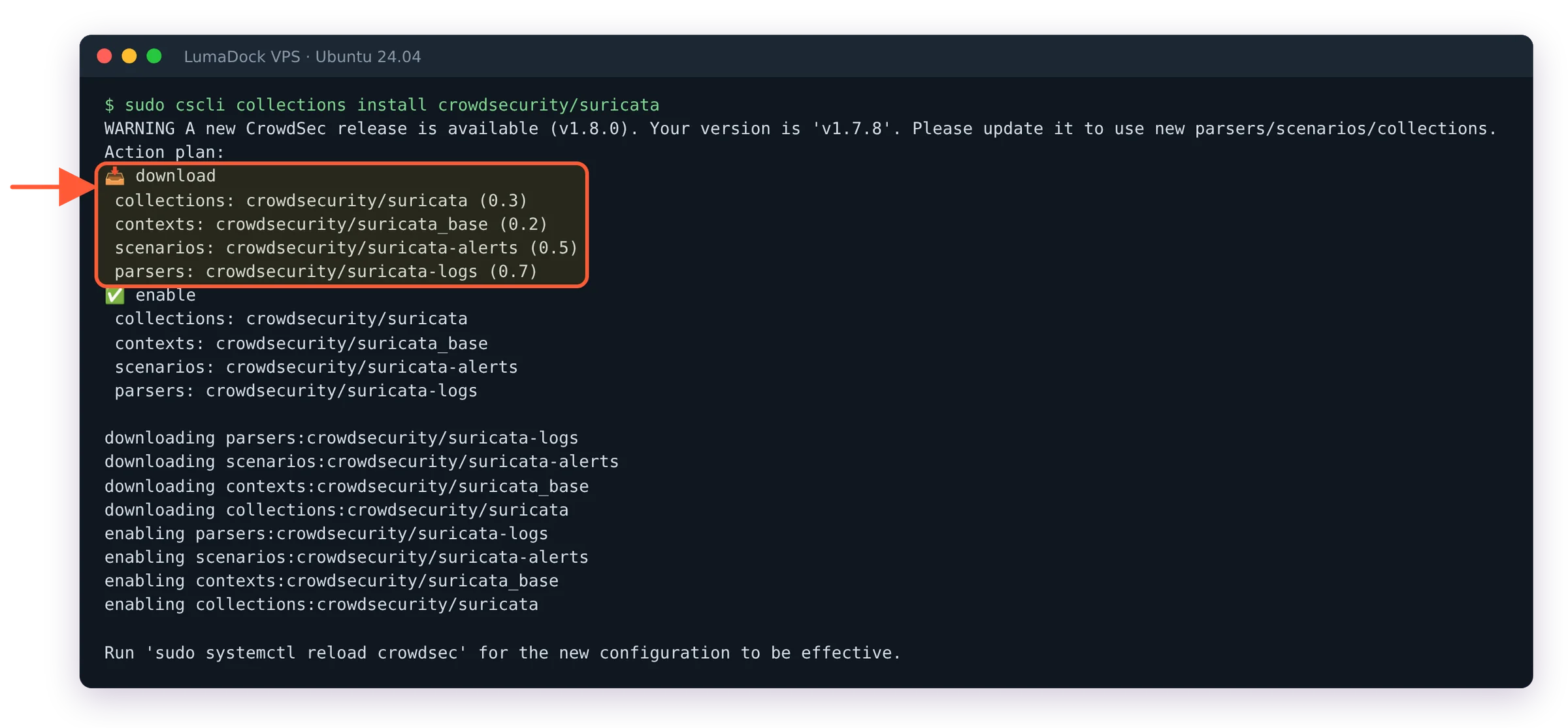
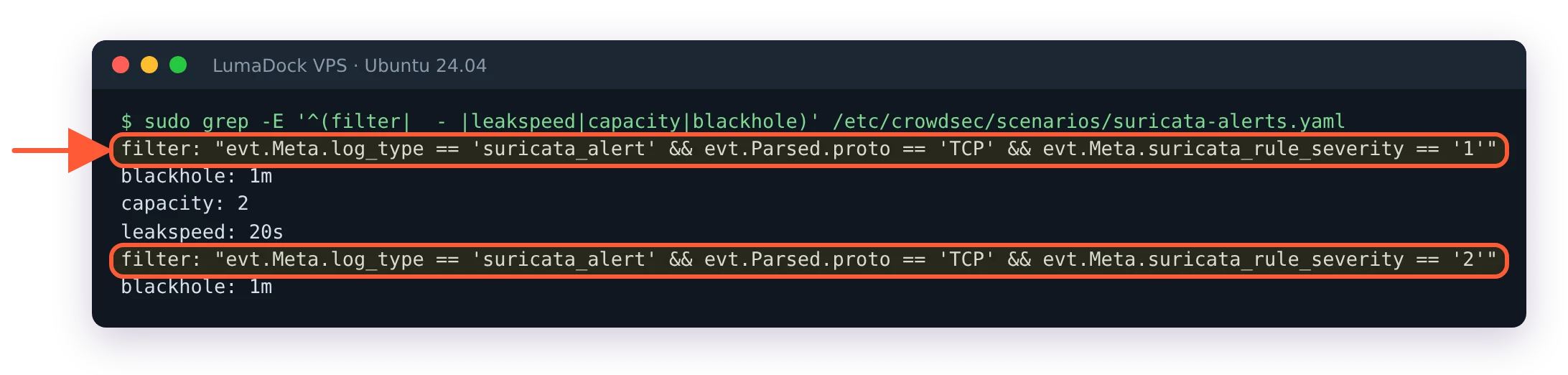
Behavior over time is the other half. A signature engine judges packets more or less individually; CrowdSec's leaky bucket scenarios judge sequences, like the same IP failing logins slowly across two hours. And every confirmed detection becomes shared reputation through the community blocklist, so the network remembers an attacker between his visits even when each visit looks innocent. If that model is new to you, the what is CrowdSec explainer walks the whole pipeline; suffice it here that Suricata has no equivalent loop, though its alerts can feed CrowdSec's, which I'll get to. That loop is also why CrowdSec ends up on machines Suricata could never justify, like a lone VPS or a Raspberry Pi reverse proxy.
CPU and memory costs on both sides
Honesty about resources decides most real deployments, so here's mine. Suricata's appetite scales with traffic and ruleset size, since it inspects every packet against thousands of signatures. On my modest home connection it sits comfortably in a couple of GB of RAM; size it for a busy gigabit link with full ET Open and you're planning dedicated cores and serious memory, plus the ongoing human cost of rule tuning, because an untuned Suricata either drowns you in alerts or silently inspects nothing you care about. That tuning tax is real and permanent.
CrowdSec's engine idles around 100 MB on my boxes and its CPU cost tracks log volume, which for a typical VPS is a rounding error. The cheapness has the same root as the limitation: parsing text lines is easy precisely because someone else (the web server) already did the expensive work of terminating the connection. CrowdSec misses what logs miss. There's no configuration that fixes that, only a different tool.
Tuning deserves its own honesty paragraph. A stock Suricata with full ET Open enabled will alert on things you don't care about within the hour, and the workflow that fixes it (managing rules with suricata-update, then disabling or thresholding noisy signature IDs one at a time) is iterative and never quite finishes. Budget a few evenings up front and a little attention monthly. CrowdSec's equivalent tax is smaller but real: hub scenarios occasionally flag your own uptime monitor or an aggressive but legitimate crawler, and you settle it with a whitelist entry instead of a signature threshold.