Back to Article List

How to install CrowdSec on Debian 12 and 13

How to install CrowdSec on Debian 12 and 13

Updated 22 October 2026

Debian ships CrowdSec in its own archive, and my advice is to skip it. The Debian 12 package is frozen at 1.4.6, which predates the AppSec component, the current hub format and roughly three years of scenario updates. Debian 13 carries something newer but it still trails the official repository, and CrowdSec is one of those tools where the detection rules matter as much as the binary.

This walkthrough uses the official repo on a Debian 12 VPS, and every command was run on a fresh Debian 12 server and on Ubuntu 24.04. Debian 13 uses the same packages but wasn't part of that test run. By the end the Security Engine will be parsing your logs and a firewall bouncer will be enforcing its bans, with the community blocklist layered on top.

If you're new to the architecture, the short version is that CrowdSec splits detection from enforcement. The engine reads logs and decides who's hostile; a separate Remediation Component (a bouncer, in CrowdSec speak) does the blocking. I've written a longer piece on what CrowdSec is and how the parts fit together if you want the full picture, and a CrowdSec vs Fail2ban comparison if you're migrating from the old guard.

Why the official repository beats the distro package

Distro archives freeze at release time. That's the right call for coreutils and a bad fit for a security tool whose parsers chase log formats and whose scenarios chase attacker behaviour. The official packagecloud repository tracks upstream, which in October 2026 means the 1.8.1 release. The 1.7 line brought cscli setup (the service detection machinery) and usage metrics that show what your bouncers are dropping, and 1.8 added bot detection to the AppSec WAF. None of that exists in 1.4.6.

The one argument for the distro package is unattended updates through Debian's own infrastructure. I don't find it convincing. CrowdSec's repo signs its packages, upgrades are boring in practice and you'd be trading a current engine for a fossil.

Add the CrowdSec repository

sudo apt update
curl -s https://install.crowdsec.net | sudo sh

Don't skip the first line on a freshly deployed server. The script installs gnupg if it's missing, and on package lists that are months old that install fails with a wall of 404 Not Found errors and "Repository installation aborted." A fresh Debian 12 VPS has no gnupg, so this is the usual case rather than a corner one.
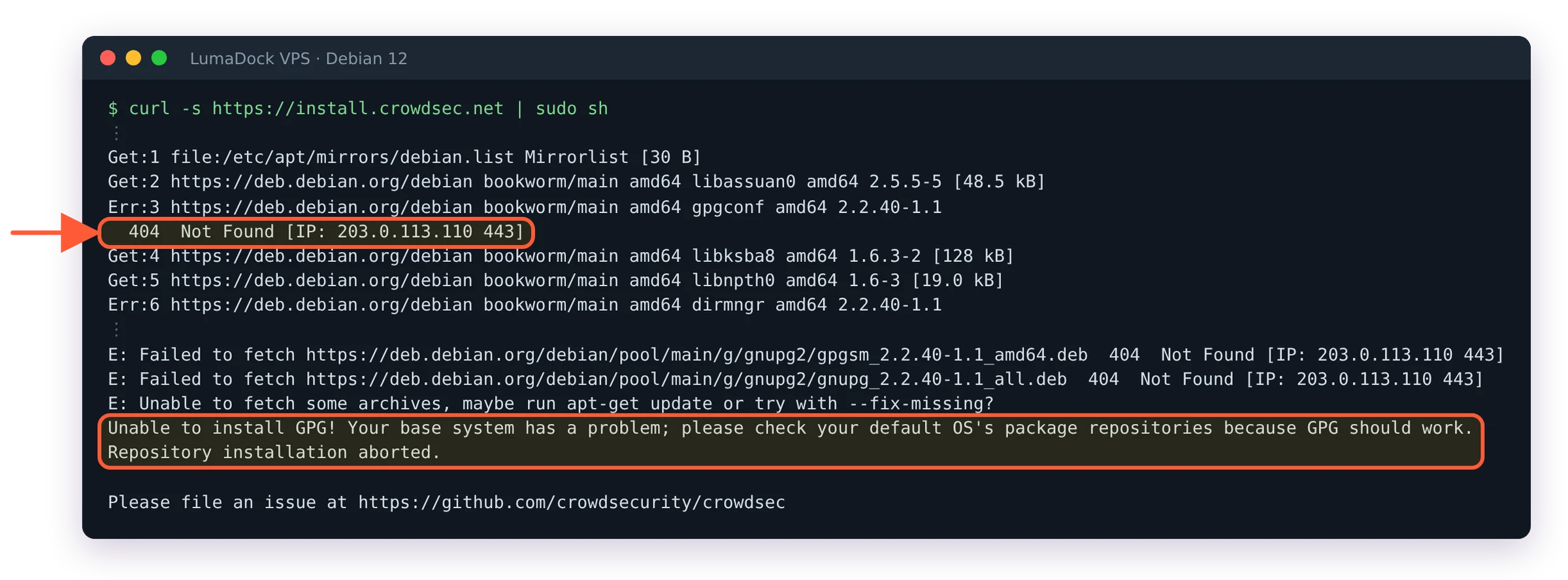
CrowdSec install script on a fresh Debian 12 VPS aborting because gnupg downloads return 404 on stale package lists

Without apt update first, the script can't install gnupg and stops.

The script detects your distribution and writes a sources file under /etc/apt/sources.list.d/. If piping a script from the internet into a root shell makes you twitch (healthy instinct), the official install docs list the manual steps: import the GPG key into /etc/apt/keyrings/ and add the packagecloud repo line yourself. Same result.

Before installing, confirm apt will pick the repo version and not Debian's:

apt-cache policy crowdsec
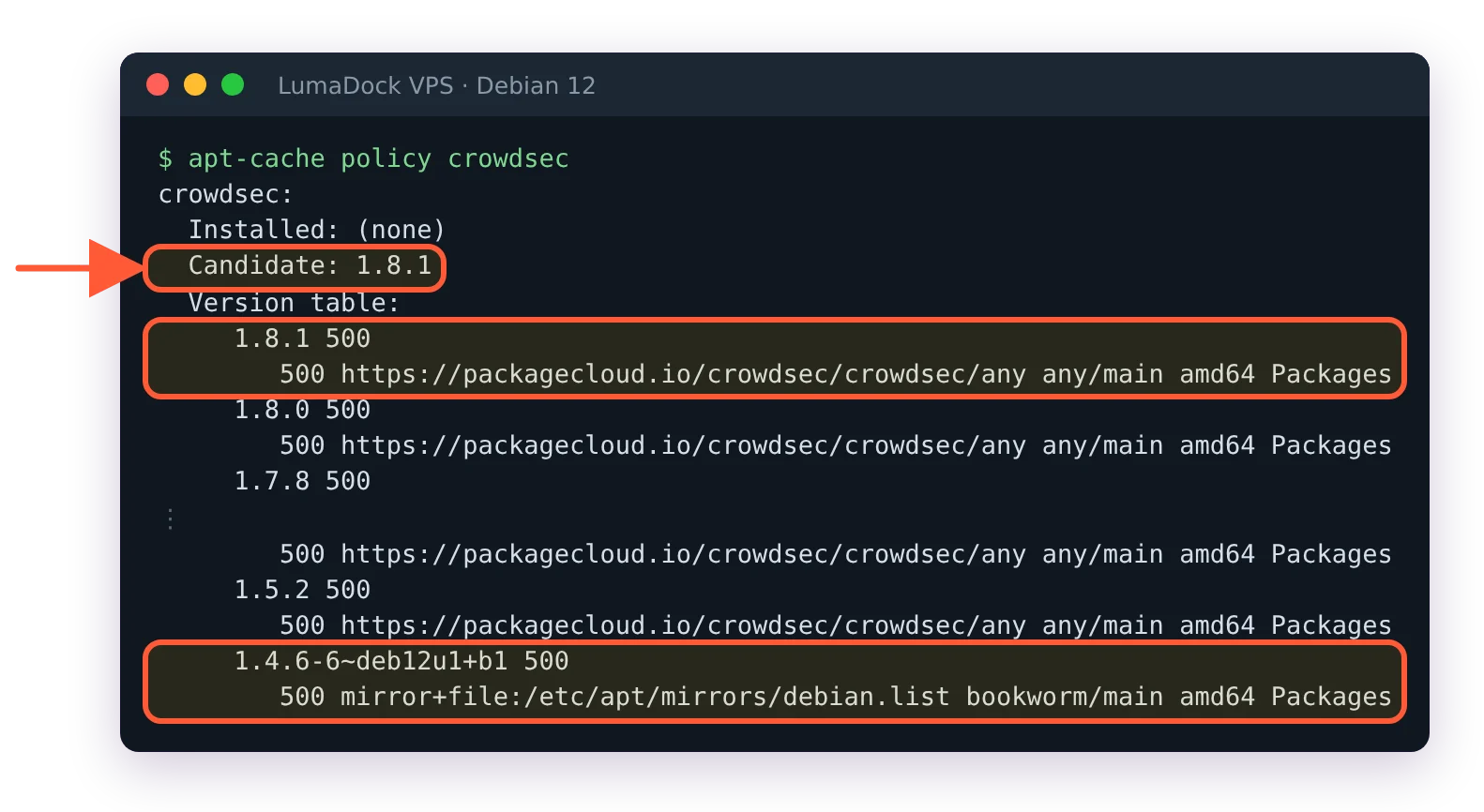
apt-cache policy crowdsec on Debian 12 showing candidate 1.8.1 from packagecloud ahead of Debian's own 1.4.6 package

The repository's 1.8.1 is the candidate; Debian's own 1.4.6 loses on version number.

The candidate should be the repository's current release (1.8.1 when I last ran this), not the 1.4.6 that Debian 12 and Ubuntu 24.04 carry. On Debian 12 and Ubuntu 24.04 the repo version wins on version number alone. If an old distro candidate wins instead, apt pinning fixes the priority; the install docs include a ready-made preferences file for exactly this. Then install:

sudo apt update
sudo apt install crowdsec

Small aside before the config spelunking starts: if this server doesn't exist yet, LumaDock has an Ubuntu 24.04 + CrowdSec template you pick during ordering. It deploys in seconds with the engine and a firewall bouncer already wired, so CrowdSec is watching from first boot and you can skip the bouncer step further down. I still think you should read on so you know what's running, but you don't have to type any of it.

What the post-install step auto-detects

The package's post-install hook runs service detection against your box (since the 1.7 line this is cscli setup doing the work). On a bare VPS it finds sshd and the system logs, installs the crowdsecurity/linux collection and registers the machine with the local API. On fresh Debian 12 and Ubuntu 24.04 servers it also added crowdsecurity/sshd and crowdsecurity/whitelist-good-actors. A collection is a bundle of parsers and scenarios; crowdsecurity/linux pulls in SSH brute force detection among other things. Check what landed:

sudo cscli collections list
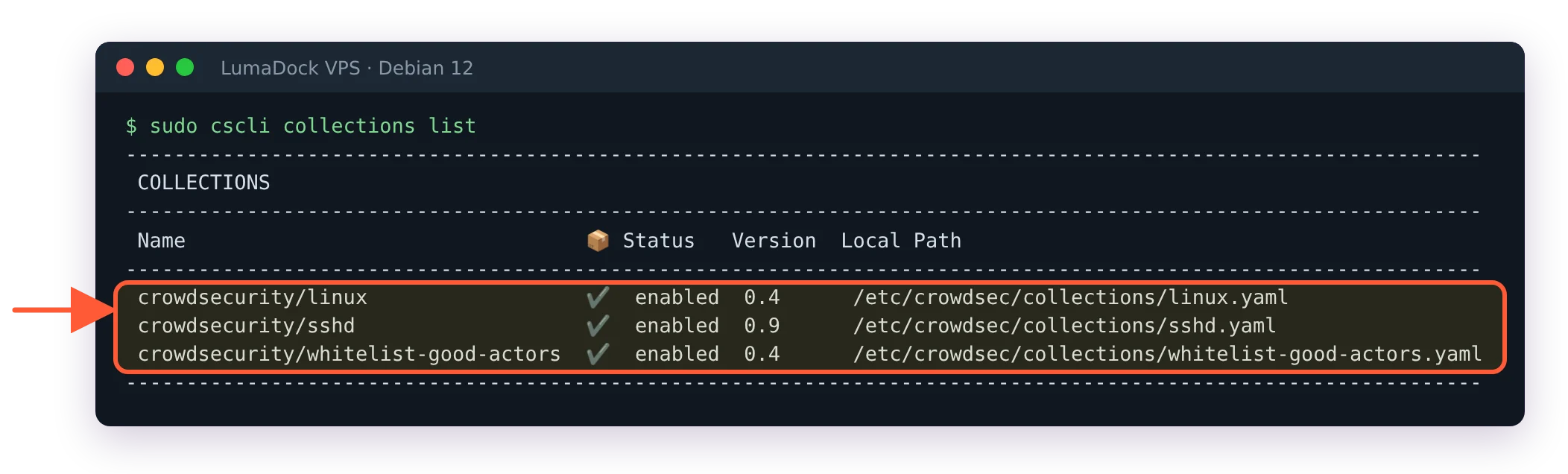
cscli collections list on Debian 12 showing crowdsecurity/linux, sshd and whitelist-good-actors enabled after install

After install, service detection enabled the linux, sshd and whitelist-good-actors collections.

If you later add nginx or Postfix, install the matching collection from the CrowdSec hub and the engine starts covering those services too.

Acquisitions on Debian: journald vs auth.log

Acquisitions tell the engine which logs to read. They live in the /etc/crowdsec/acquis.d/ directory, where setup writes what it detected as setup.*.yaml files, and on older installs in /etc/crowdsec/acquis.yaml too. A fresh 1.8 install doesn't create that second file. Here's the wrinkle that catches people on modern Debian: rsyslog isn't installed on a fresh Debian 12 VPS, so /var/log/auth.log doesn't exist and SSH events live in journald instead.
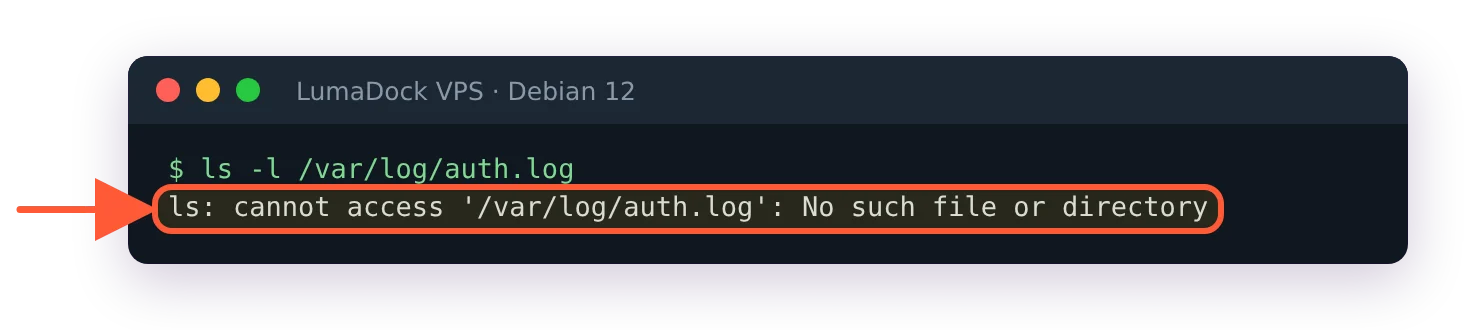
ls -l /var/log/auth.log on Debian 12 failing with No such file or directory

No rsyslog on a fresh Debian 12 VPS, so no /var/log/auth.log.

Setup handles this on its own. It writes /etc/crowdsec/acquis.d/setup.sshd.yaml with a journald source for ssh.service, which looks like this:

source: journalctl
journalctl_filter:
 - "_SYSTEMD_UNIT=ssh.service"
labels:
  type: syslog
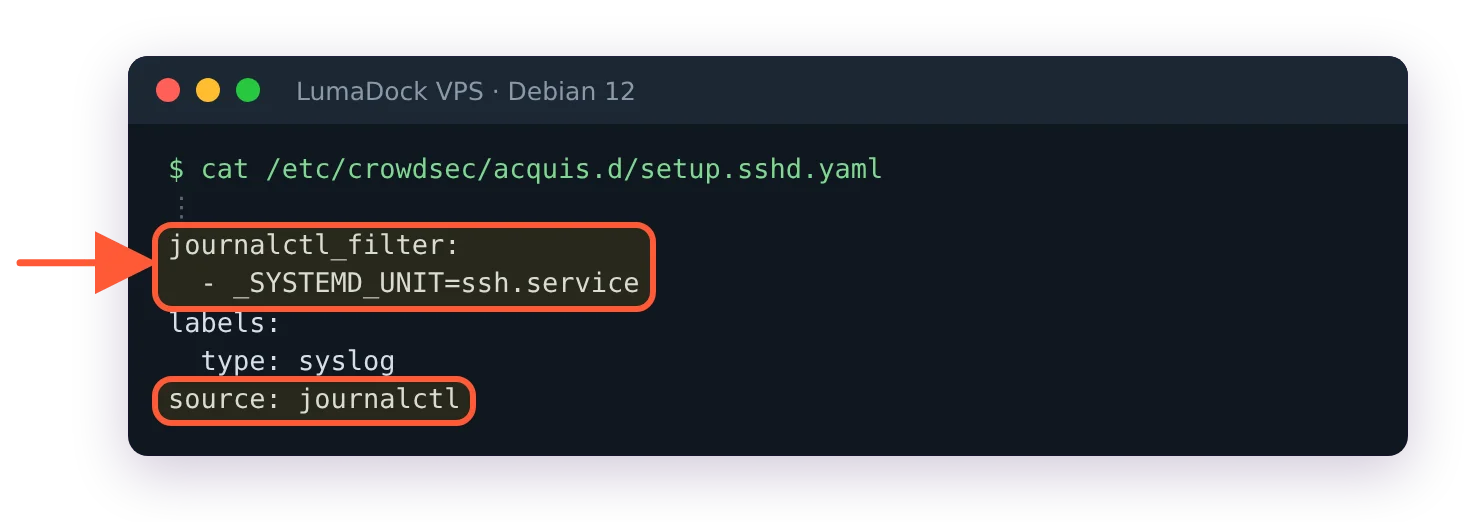
setup.sshd.yaml written by cscli setup on Debian 12 with a journalctl source filtered on ssh.service

What setup wrote on its own on Debian 12: the same journald acquisition.

It also writes setup.linux.yaml for /var/log/syslog, messages and kern.log, none of which exist without rsyslog. CrowdSec logs a No matching files for pattern warning for each in /var/log/crowdsec.log and carries on, so SSH detection still works. If you write an acquisition by hand for a file that's never written, that warning is the only sign. Ubuntu 24.04 still ships rsyslog, so there you'll see a file acquisition on /var/log/auth.log instead, which works fine.

After any acquisition change, restart the engine with sudo systemctl restart crowdsec.

Confirm detection with cscli metrics and alerts

Two checks. First, is the engine reading anything at all?

sudo cscli metrics
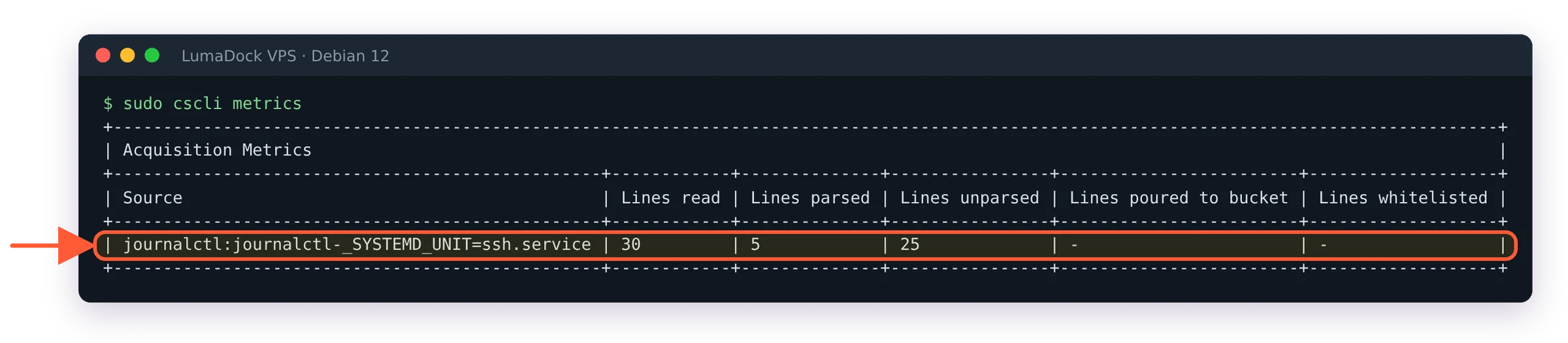
cscli metrics acquisition table on Debian 12 with lines read and parsed from the ssh.service journal

Lines read and parsed from the ssh.service journal mean the engine is reading SSH logs.

The acquisition table shows lines read and lines parsed per source. A source missing from the table, or showing zero lines read, means your acquisition path is wrong. Lines read with nothing parsed at all usually means a label mismatch. A high unparsed count next to a healthy parsed count is normal, since sshd logs plenty of lines no scenario cares about.

Second, trigger it on purpose. From a different machine, fail a handful of SSH logins against the server. One warning about this test: since 1.6.3 the engine whitelists private RFC1918 ranges by default, so hammering from a LAN address will never produce a ban. Test from a genuinely external IP. Then:

sudo cscli alerts list
sudo cscli decisions list

You should see an SSH brute force alert against your test IP and a matching ban decision. On a VPS with a public IP you may not need the test at all: on a fresh Debian 12 test server a real SSH brute-force alert and a four-hour ban showed up about two minutes after install (crowdsecurity/ssh-slow-bf first, then crowdsecurity/ssh-bf a couple of minutes later). Nothing is blocked yet, though, which brings us to the part people skip.

cscli decisions list on Debian 12 with four-hour bans from the ssh-bf and ssh-slow-bf scenarios against internet IPs

Real SSH brute-force bans from the internet, the first about two minutes after install.

Install the firewall bouncer

The engine alone is a smoke detector. Decisions pile up in the local API and nothing enforces them until a Remediation Component subscribes. For a plain VPS the firewall bouncer is the right first one:

sudo apt install crowdsec-firewall-bouncer-iptables

There's a crowdsec-firewall-bouncer-nftables package as well, and on Debian 12/13 (where iptables is a compatibility shim over nftables) it's arguably the cleaner pick. I've gone deep on modes, ipsets and the Docker traps in a dedicated firewall bouncer guide, so here I'll just verify it registered:

sudo cscli bouncers list

cscli bouncers list on Debian 12 showing the iptables firewall bouncer registered, valid and with a recent last API pull

The firewall bouncer is registered and pulling decisions: a recent last API pull is what you want.

The bouncer should appear with a recent pull timestamp. Now repeat the failed-login test from outside and watch the connection start timing out mid-test. Before you do, read up on rolling CrowdSec out without locking yourself out; testing brute force detection from the same laptop you administer the box from is a classic way to ban your own IP.

Console enrollment and the community blocklist

Your engine already shares alert signals with the Central API and receives the community blocklist in return, a curated feed of IPs currently attacking the wider CrowdSec network. Verify the link is healthy:

sudo cscli capi status
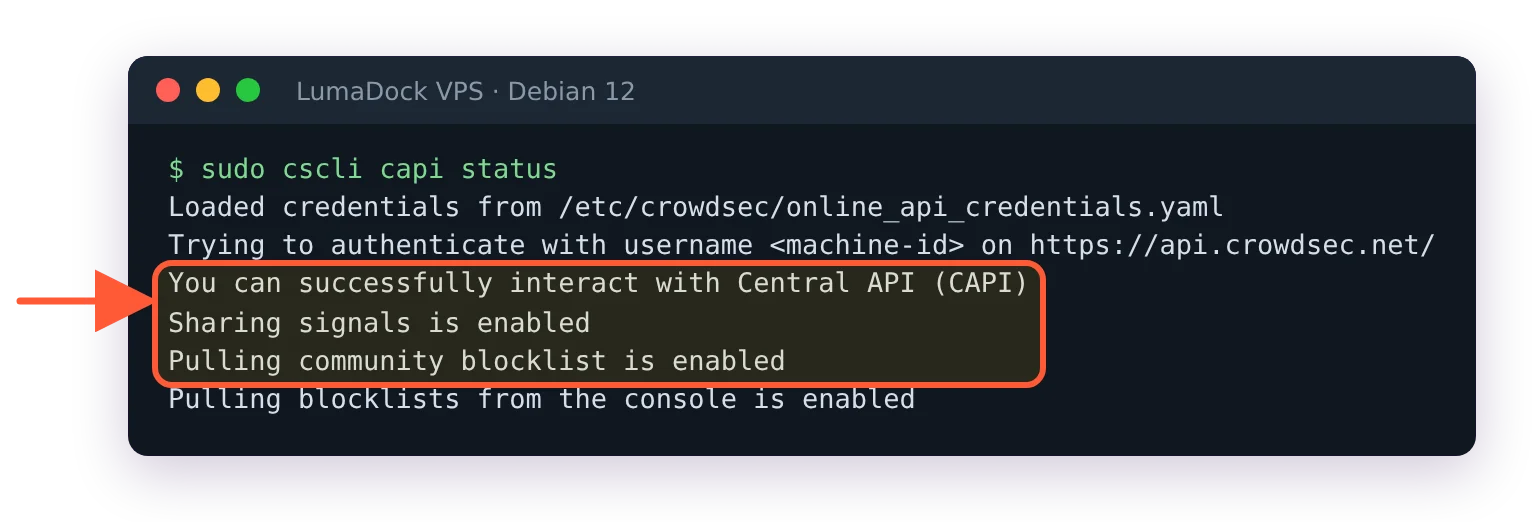
cscli capi status on Debian 12 confirming the Central API connection with signal sharing and blocklist pulling enabled

The Central API link is healthy: signal sharing and the community blocklist pull are enabled.

"Enabled" means the pull is switched on, not that a list has arrived. On a new install the first community blocklist can take a while; on the servers this guide was tested on it showed up after about two hours, and sudo cscli decisions list --origin CAPI lists it once it's there.

Enrolling the engine in the free console at app.crowdsec.net adds a web view of your alerts plus extra blocklist subscriptions. Grab the enrollment key from the console and run:

sudo cscli console enroll YOUR_ENROLL_KEY

Then approve the machine in the web UI and restart crowdsec. sudo cscli console status shows the change: Enrolled flips from not enrolled to enrolled. Until you enroll, crowdsec.log carries a "Machine is not enrolled in the console" error at startup, which is harmless. I resisted the console for a while out of self-hosting stubbornness and eventually caved; seeing which scenarios fire across several servers in one place is worth the account.


Your idea deserves better hosting

24/7 support 30-day money-back guaranteeRefund covers the VPS plan on your first order. Cancel anytime
Ciclo de Facturación

VPS.S1

$5.99 Save  17 %
$4.99 Mensual
  • 2 vCPU AMD EPYC
  • 2 GB RAMMEMORIA
  • 30 GB NVMeDISCO
  • Ancho de banda sin medir
  • IPv4 & IPv6El soporte IPv6 no está disponible actualmente en Francia, Finlandia ni Países Bajos. incluidos

VPS.S3

$14.99 Save  33 %
$9.99 Mensual
  • 4 vCPU AMD EPYC
  • 6 GB RAMMEMORIA
  • 70 GB NVMeDISCO
  • Ancho de banda sin medir
  • IPv4 & IPv6El soporte IPv6 no está disponible actualmente en Francia, Finlandia ni Países Bajos. incluidos

VPS.S4

$19.99 Save  20 %
$15.99 Mensual
  • 6 vCPU AMD EPYC
  • 8 GB RAMMEMORIA
  • 80 GB NVMeDISCO
  • Ancho de banda sin medir
  • IPv4 & IPv6El soporte IPv6 no está disponible actualmente en Francia, Finlandia ni Países Bajos. incluidos

EPYC VPS.P1

$8.99 Save  22 %
$6.99 Mensual
  • 2 vCPU AMD EPYC
  • 4 GB RAMMEMORIA
  • 40 GB NVMeDISCO
  • Ancho de banda sin medir
  • IPv4 & IPv6El soporte IPv6 no está disponible actualmente en Francia, Finlandia ni Países Bajos. incluidos
  • Backup automático gratisIncluye un espacio de backup que puedes configurar para que se ejecute a diario, cada semana o cada mes.

EPYC VPS.P2

$16.99 Save  24 %
$12.99 Mensual
  • 2 vCPU AMD EPYC
  • 8 GB RAMMEMORIA
  • 80 GB NVMeDISCO
  • Ancho de banda sin medir
  • IPv4 & IPv6El soporte IPv6 no está disponible actualmente en Francia, Finlandia ni Países Bajos. incluidos
  • Backup automático gratisIncluye un espacio de backup que puedes configurar para que se ejecute a diario, cada semana o cada mes.

EPYC VPS.P4

$29.99 Save  23 %
$22.99 Mensual
  • 4 vCPU AMD EPYC
  • 16 GB RAMMEMORIA
  • 160 GB NVMeDISCO
  • Ancho de banda sin medir
  • IPv4 & IPv6El soporte IPv6 no está disponible actualmente en Francia, Finlandia ni Países Bajos. incluidos
  • Backup automático gratisIncluye un espacio de backup que puedes configurar para que se ejecute a diario, cada semana o cada mes.

EPYC VPS.P5

$39.99 Save  25 %
$29.99 Mensual
  • 8 vCPU AMD EPYC
  • 16 GB RAMMEMORIA
  • 180 GB NVMeDISCO
  • Ancho de banda sin medir
  • IPv4 & IPv6El soporte IPv6 no está disponible actualmente en Francia, Finlandia ni Países Bajos. incluidos
  • Backup automático gratisIncluye un espacio de backup que puedes configurar para que se ejecute a diario, cada semana o cada mes.

EPYC VPS.P6

$59.99 Save  25 %
$44.99 Mensual
  • 8 vCPU AMD EPYC
  • 32 GB RAMMEMORIA
  • 200 GB NVMeDISCO
  • Ancho de banda sin medir
  • IPv4 & IPv6El soporte IPv6 no está disponible actualmente en Francia, Finlandia ni Países Bajos. incluidos
  • Backup automático gratisIncluye un espacio de backup que puedes configurar para que se ejecute a diario, cada semana o cada mes.

EPYC VPS.P7

$69.99 Save  29 %
$49.99 Mensual
  • 16 vCPU AMD EPYC
  • 32 GB RAMMEMORIA
  • 240 GB NVMeDISCO
  • Ancho de banda sin medir
  • IPv4 & IPv6El soporte IPv6 no está disponible actualmente en Francia, Finlandia ni Países Bajos. incluidos
  • Backup automático gratisIncluye un espacio de backup que puedes configurar para que se ejecute a diario, cada semana o cada mes.

Genoa VPS.G2

$24.99 Save  20 %
$19.99 Mensual
  • 2 vCPUAMD EPYC Genoa de 4ª generación 9xx4 a 3,25 GHz o similar, en arquitectura Zen 4. AMD EPYC G4
  • 4 GB DDR5MEMORIA
  • 50 GB NVMeDISCO
  • Ancho de banda sin medir
  • IPv4 & IPv6El soporte IPv6 no está disponible actualmente en Francia, Finlandia ni Países Bajos. incluidos
  • Backup automático gratisIncluye un espacio de backup que puedes configurar para que se ejecute a diario, cada semana o cada mes.

Genoa VPS.G4

$44.99 Save  22 %
$34.99 Mensual
  • 4 vCPUProcesador AMD EPYC con núcleos vCPU dedicados, en hardware de servidor empresarial. AMD EPYC G4
  • 8 GB DDR5MEMORIA
  • 100 GB NVMeDISCO
  • Ancho de banda sin medir
  • IPv4 & IPv6El soporte IPv6 no está disponible actualmente en Francia, Finlandia ni Países Bajos. incluidos
  • Backup automático gratisIncluye un espacio de backup que puedes configurar para que se ejecute a diario, cada semana o cada mes.

Genoa VPS.G6

$89.99 Save  22 %
$69.99 Mensual
  • 8 vCPUProcesador AMD EPYC con núcleos vCPU dedicados, en hardware de servidor empresarial. AMD EPYC G4
  • 16 GB DDR5MEMORIA
  • 200 GB NVMeDISCO
  • Ancho de banda sin medir
  • IPv4 & IPv6El soporte IPv6 no está disponible actualmente en Francia, Finlandia ni Países Bajos. incluidos
  • Backup automático gratisIncluye un espacio de backup que puedes configurar para que se ejecute a diario, cada semana o cada mes.

Genoa VPS.G7

$159.99 Save  22 %
$124.99 Mensual
  • 8 vCPUProcesador AMD EPYC con núcleos vCPU dedicados, en hardware de servidor empresarial. AMD EPYC G4
  • 32 GB DDR5MEMORIA
  • 250 GB NVMeDISCO
  • Ancho de banda sin medir
  • IPv4 & IPv6El soporte IPv6 no está disponible actualmente en Francia, Finlandia ni Países Bajos. incluidos
  • Backup automático gratisIncluye un espacio de backup que puedes configurar para que se ejecute a diario, cada semana o cada mes.

AMD Ryzen VPS.R1

$16.99 Save  18 %
$13.99 Mensual
  • 1 CPU dedicada AMD Ryzen 9 7950X a 4,5 GHz o similar, en arquitectura Zen 4. vCPU
  • 4 GB DDR5MEMORIA
  • 50 GB NVMeDISCO
  • Ancho de banda sin medir
  • IPv4 & IPv6 incluidos El soporte IPv6 no está disponible actualmente en Francia, Finlandia ni Países Bajos.
  • Backup automático incluido

AMD Ryzen VPS.R2

$29.99 Save  17 %
$24.99 Mensual
  • 2 CPU dedicadas AMD Ryzen 9 7950X a 4,5 GHz o similar, en arquitectura Zen 4. vCPU
  • 8 GB DDR5MEMORIA
  • 100 GB NVMeDISCO
  • Ancho de banda sin medir
  • IPv4 & IPv6 incluidos El soporte IPv6 no está disponible actualmente en Francia, Finlandia ni Países Bajos.
  • Backup automático incluido

AMD Ryzen VPS.R4

$109.99 Save  18 %
$89.99 Mensual
  • 8 CPU dedicadas AMD Ryzen 9 7950X a 4,5 GHz o similar, en arquitectura Zen 4. vCPU
  • 32 GB DDR5MEMORIA
  • 400 GB NVMeDISCO
  • Ancho de banda sin medir
  • IPv4 & IPv6 incluidos El soporte IPv6 no está disponible actualmente en Francia, Finlandia ni Países Bajos.
  • Backup automático incluido

*VAT excluded.

INCLUDED WITH EVERY PLAN

✓ No setup fees ✓1 Gbps network
✓ Full root access on KVM ✓ Free server monitoring ✓ Firewall management ✓24/7 support

Upgrades: apt packages and hub objects

Two things version independently. The engine and bouncer upgrade through apt like everything else:

sudo apt update && sudo apt upgrade

Parsers, scenarios and collections upgrade through the hub:

sudo cscli hub update
sudo cscli hub upgrade
sudo systemctl reload crowdsec

On a server that hasn't been updated in a while, the apt pair also pulls in Debian's own updates; on the fresh Debian 12 test server that meant a point release and a new kernel, so reboot when convenient.

I run the hub pair monthly. New scenarios and parser fixes land continuously, and an apt upgrade alone won't fetch them.

Uninstall CrowdSec cleanly

sudo systemctl stop crowdsec crowdsec-firewall-bouncer
sudo apt purge crowdsec crowdsec-firewall-bouncer-iptables
sudo rm -rf /etc/crowdsec /var/lib/crowdsec
sudo rm -f /var/log/crowdsec*.log
sudo apt autoremove

Purge removes the packages and most of the config; the manual rm clears hub data and the local decision database that survive it. The two extra lines remove the three CrowdSec log files in /var/log (they hold attacker IPs and machine names) and the ipset tools the bouncer pulled in. The install script's repository file and signing key stay behind as well. If you're done with CrowdSec for good, remove them too:

sudo rm /etc/apt/sources.list.d/crowdsec_crowdsec.list /etc/apt/keyrings/crowdsec_crowdsec-archive-keyring.gpg
sudo apt update

From here, apt install crowdsec would give you Debian's 1.4.6 again. If the machine was enrolled, remove it from the console too so it stops showing up as offline.

That's a complete install. When something misbehaves later, my CrowdSec troubleshooting cheat sheet covers the errors I hit in practice, and once SSH is boring again the same engine can grow into a web application firewall with the AppSec component. That one deserves its own afternoon.

Questions?

Can I run CrowdSec on a 1 GB RAM VPS?

Yes. On a Debian 12 test server with the default SSH collections, the engine used about 235 MB a few minutes after install and the firewall bouncer about 23 MB, so a 1 GB VPS has room to spare. Memory pressure only becomes a topic if you parse very high-volume web logs on the same small box, and even then the fix is usually trimming acquisitions rather than buying RAM.

Ellie Grace Hayes
About the author

Ellie Grace Hayes

I grew up in Minnesota and started working remotely before I decided that travelling was going to become a permanent part of my life. And it kinda did, more or less... I tend to stay somewhere for a month or two, sometimes longer if I like the place (so "digital nomad" is technically accurate, even if most days are much less exciting than the term suggests). Usually I'm at a desk in a rented room trying to work out why a command behaved differently on two supposedly identical machines :)

I came into technical writing through support work & community tutorials. Linux was the first subject I wrote about, but since then I've wandered into containers, hosting, networking plus a lot of self-hosted software. I've played Minecraft since I was a kid and still go through phases where I get completely absorbed in it for a few weeks. I don't have a five-year plan. I've tried - it keeps becoming a six-month plan instead.

Deploy your next project in seconds

Bring your winning ideas online faster, with modern hardware and unmetered bandwidth. Join a European cloud trusted by thousands of developers and businesses worldwide.